Hermione's Dillema
A story in skulls

This sessions, to our great grief we pronounce,
Even pushes 'gainst our heart: the party tried
The daughter of a king, our wife, and one
Of us too much beloved. Let us be clear'd
Of being tyrannous, since we so openly
Proceed in justice, which shall have due course,
Even to the guilt or the purgation.-Leontes, The Winter’s Tale, Act 3 Scene 2
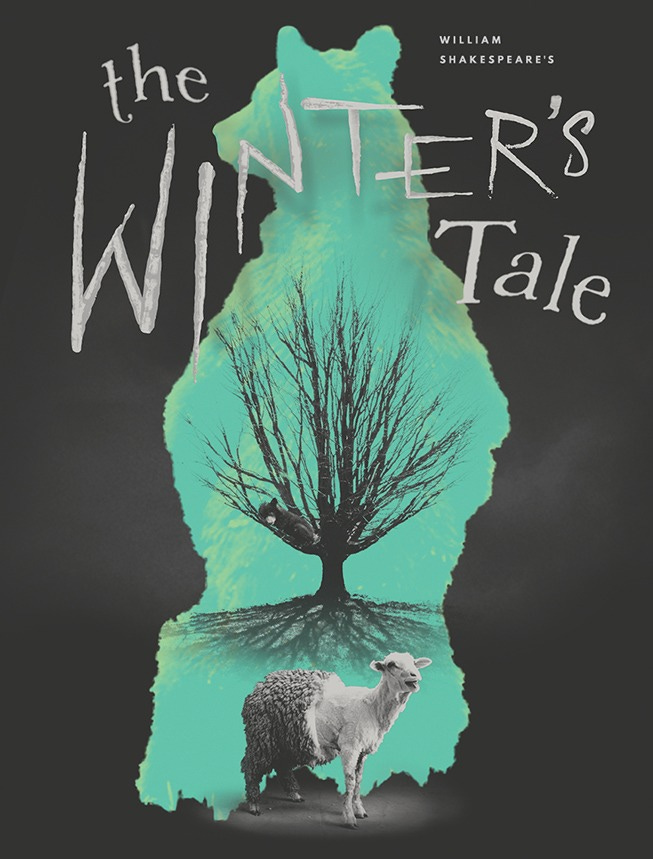
Shakespeare’s The Winter’s Tale holds a special place in my heart. When I was performing Shakespeare plays in high school, it was the last one I was in before graduating. I also got to play a type of part I was not at all used to: the lead romance. I turned out to be utterly unsuited to the role, but our performance turned out okay nonetheless. I have fond memories of the play, and in the course of thinking about a recent dilemma, I found myself feeling some familiar feelings. You see, the inciting incident of the play is the king of Sicilia; Leontes, becoming utterly convinced, despite a lack of evidence or any real reason to think such a thing, that his wife Hermione is having an affair with his long time friend; Polixenes, king of Bohemia. Leontes mistreats Hermione, and eventually brings her to a fallacious trial on charges of treason both for the alleged affair, and his newfound belief that they have conspired to kill him. Despite Hermione and her lady-in-waiting Paulina continually pleading with Leontes both for the life of Hermione, and the life of their as-yet-unborn child, Hermione is imprisoned and her and the child are both shortly after pronounced dead. Leontes’ mistakes in the first half of the play ripple throughout the rest of the show and cause a great many hardships for his family, and I have begun to feel like I am in the middle of a similar situation.
“It’s designed to do what it does do and what it does do it does do very well, doesn’t it. Yes it does. I think it does, do you? I do. Hope you do too, do you?”
This phrase was etched into the minds of many a young child in the early two thousands, including me. It was coined by a man named Ken Ham sometime in the nineties. Ham is a well known name in the earth science sphere of academia for founding one of its most obstinate resistors: a company called Answers in Genesis. AiG as it is informally known, is a dirty word to many a scientist because it is among the leading publishers of young-earth creationist research and rhetoric in the world. For those not in the know, young-earth creationism is a branch of fundamentalist Christianity that denies a number of important theories and claims in geology, astronomy, and biology, centrally: uniformitarianism, the Big Bang, and Darwinian evolution. They get compared to the flat earth and anti-vax movements quite often, and there is a perhaps unsurprising overlap between the three communities. I bring this up only because I heard an anecdote about flat-earthers one time that I increasingly find applies to this community I was raised in. It went something like this: all of their rhetoric is about “trusting your eyes,” and taking observations at face value with no additional nuance, yet all of their actual research is built around disproving basic observations.
The “Its designed to do…” phrase was coined in description of an animal from Ham’s homeland of Australia: the duck-billed platypus. The platypus is a favorite of creationists. They see it as the apex of one of their favorite arguments which essentially boils down to the idea that an organism is a complete package built for a specific role, that the mere idea of finding “transitional forms” is laughable, and any indication that an organism has changed is simply God re-using a good design. And indeed on first glance the platypus does seem to be an enigma. It has a bill like a duck, lays eggs and has venom like a snake, and yet is classified as a mammal. So, what are evolutionary scientists to do? Much like Leontes, I have increasingly found that major assumptions I have made in the past were leading me to make major mistakes. Mainly, I and anyone else who grew up under creationist ideology had assumed that we understood the anatomy of the platypus.
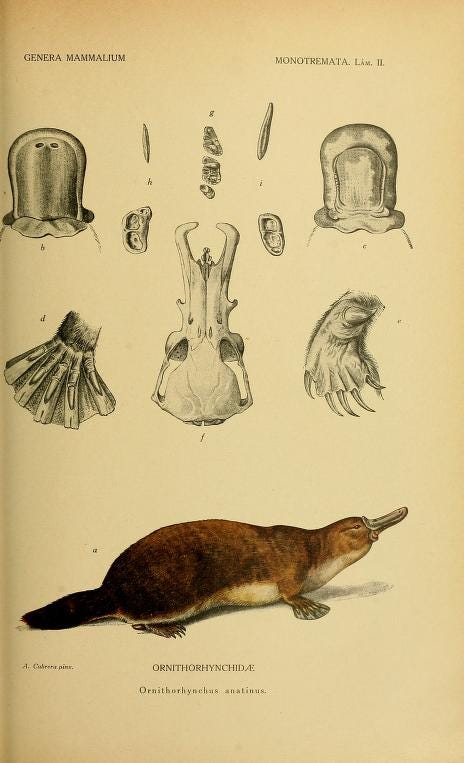
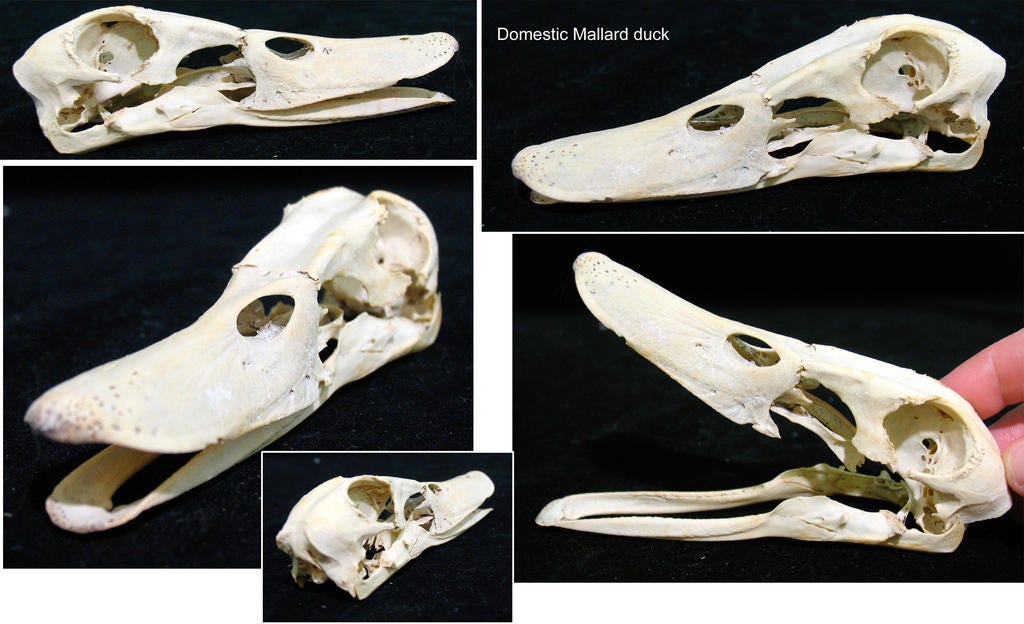
Thankfully, I have been able to assume the role of Paulina in this analogy and slowly push back against my tyrannical assumptions. Lets go through each of the platypus’s strange features one-by-one and talk through the evolutionary explanation for each. First, the titular bill. The bill of the platypus does bear a superficial similarity to that of birds. However, if one looks at the underlying anatomy, you see that the two structures are very different. A true duck’s bill is mostly bone, a part of the skull. They have a sheet of keratin covering them to protect the bone and allow for nerves to exist in the beak, and thus a sense of touch. The bill of a platypus; as shown in the illustration above, is only partly constructed of bone, with a large void in the center, and attachment points on the sides for the large amounts of soft tissue that it supports. See, the two structures have entirely different purposes. The beak of a bird is a digestive organ, used to process food and essentially replace teeth (though some bird beaks do have points and serrations for processing specific foods). A platypus still has digestive teeth in its mouth, because its bill is not for processing food, it is almost entirely a sensory organ, used to find prey underwater similarly to how sharks locate their prey. This, admittedly does cause an entirely different set of evolutionary questions to crop up, but features like this have appeared in many animal families, and so explaining it doesn’t pose a serious problem.
Next lets discuss the platypus’s seemingly reptilian features. First, the venom. Male platypuses produce a painful venom specifically during their mating season, and deliver it through a pair of spurs on their hind feet. The venom is painful but not deadly to humans. Interestingly, the venom is similar; but not the same in chemical composition, as the venom produced by some snakes and spiders, which implies that any evolution that produced similar venom in those two disparate groups could similarly create it in a mammal. However, there is a far grander problem with the use of this feature to rebut evolution, which has largely only come to light after Ham created his ism. You see, Ham’s platypus refrain would seem to imply that the platypus is unique in being a mammal possessing venom, however that is wrong. Several species of shrews and their relatives have a venomous bite. Slow lorises; a small family of primates, also have a venomous bite. Finally, the anti-coagulant present in the feeding secretions of vampire bats is also considered a sub-type of venom. This coupled with the discovery of venom delivery structures in some fossil mammals has led some scientists to posit that venom was a more common feature in ancestral mammals, and modern mammals have; rather than develop it, instead been the ones to lose it.
Now finally we confront the eggs. Once again, the way the original refrain is phrased and explained implies 1. that giving live birth is an exclusively mammalian feature, and 2. that laying eggs is exclusively a reptilian one. Neither of these is true. Snakes and sharks are two examples of extant animals that are both capable of giving live birth. Admittedly, this is the oddity that requires the greatest reliance on evolution to explain, but there is indeed a reasonable explanation. Eggs are really important evolutionarily. They are believed to be part of the reason the first tetrapods were able to leave the water and become amphibians and reptiles. As a result of this, eggs are the ancestral way of reproducing for all of the land-dwelling vertebrates. The advent of live birth in mammals is not a date that we have a specific example for, but we have a few clues to look at. There are three main groups of mammals: the Metatheria (marsupials), the Monotremata (playpuses and echidnas), and the Eutheria (the placental mammals). The oldest definitive monotreme in the fossil record is called Teinolophos. It is a small animal discovered in the Early Cretaceous rocks of Australia (a fascinating coincidence with the range of the extant monotremes). The Cretaceous period is a fascinating time in general for mammals. Several known animals from the time would be superficially indistinguishable from mammals to the average viewer. Many are believed to have had fur, and cared for their young, two very iconic mammal traits. However, the mammals were still developing significant changes throughout the Mesozoic, obtaining things like endothermy (warm-blooded-ness), a few internal anatomical quirks that identify modern mammals today, and most crucially, the ability to give live birth. The current most widely accepted theory of monotreme origins is that sometime before mammals developed live-birth, the monotremes split off. They simply never developed it. This lines up well with the fact that our extant monotremes also have less well developed endothermy than the other extant mammals. This split would of course have had to take place before the advent of their oldest known member, Teinopholos, meaning it had to take place sometime in the Mesozoic era. As of now we don’t know exactly when, but it seems likely that while the most famous dinosaurs were stomping around above them, the humble mammals were developing their most iconic features. This is the beginning of Hermione’s case.
Since what I am to say must be but that
Which contradicts my accusation and
The testimony on my part no other
But what comes from myself, it shall scarce boot me
To say 'not guilty:' mine integrity
Being counted falsehood, shall, as I express it,
Be so received. But thus: if powers divine
Behold our human actions, as they do,
I doubt not then but innocence shall make
False accusation blush and tyranny
Tremble at patience.Hermione, The Winter’s Tale, Act 3 Scene 2
In summation, while the platypus is not exactly the monument to evolution that something like Ambulocetus or Archaeopteryx is, I really can’t abide people continuing to go on thinking its a total mystery either. We really do have a surprisingly good idea of how and why they are the way they are, and letting our thoughts terminate because of an initial impression is something I am now seeking to actively root out in my thoughts and words. By the way, creationists aren’t the only ones who can be blinded by dogma or conventional wisdom. For proof look no further than the work of geologist J Harlan Bretz in proposing the existence of the Missoula Lake Floods as an explanation for how the Channeled Scablands in the Northwestern US were formed. His ideas took years to be taken seriously, and even longer to become commonly accepted precisely because they were perceived as arguing for a more catastrophic Creationist-aligned view.
Its at this point in the essay that I have to come clean about something: I am not Paulina in this analogy. For years of my life I took this view of evolution as truth. I didn’t think critically about what I was being told. I didn’t fight back against what was untrue. It took being confronted by the most meaningful possible examples for me to finally change course. But, there should be no shame in falling for a grift, especially as a child. There is only shame in continuing to follow a grift once you’ve seen its true nature. So its with all that in mind that I want to present for the final chunk of this essay that very example that got me to rethink everything. In many ways I think these animals are the antithesis of the platypus. While a platypus seems like a walking contradiction at first, but is surprisingly explainable, the gorgonopsians seem like rather generic animals to the untrained eye, but reveal some very interesting contradictions in the minutia of their anatomy.
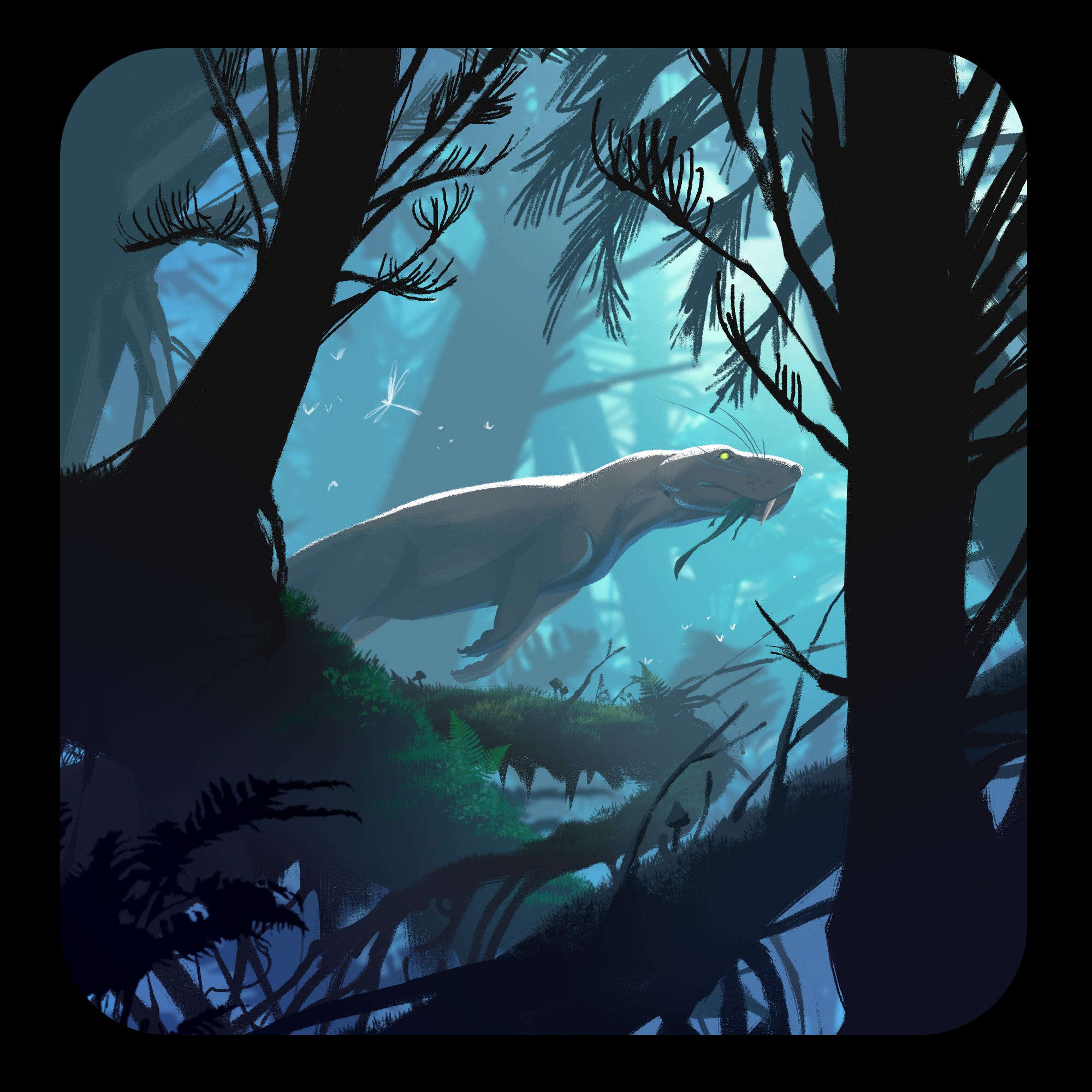
Anyone who has spent significant time with me in the last 3-4 years has probably heard me bring up the gorgonopsians. Its a new level of hipster to find that dinosaurs aren’t niche enough for you. Gorgonopsians are a family of Permian synapsids found in Russia and most commonly in South Africa. The Permian period comes before the Mesozoic era in the geologic column, thus predating the dinosaurs, and more importantly, predating the mammals. They appeared near the end of the period, and were top predators in their areas, thought there were smaller ones that served in the role of smaller carnivores. The synapsids are the family that would eventually produce the mammals, but in the Permian they hadn’t quite finished forming. The gorgonopsians are two steps away from the cynodonts: the family that would produce the true mammals, and so they have a very curious combination of mammalian features and reptilian features (which are really just ancestral tetrapod features that reptiles happen to have maintained).
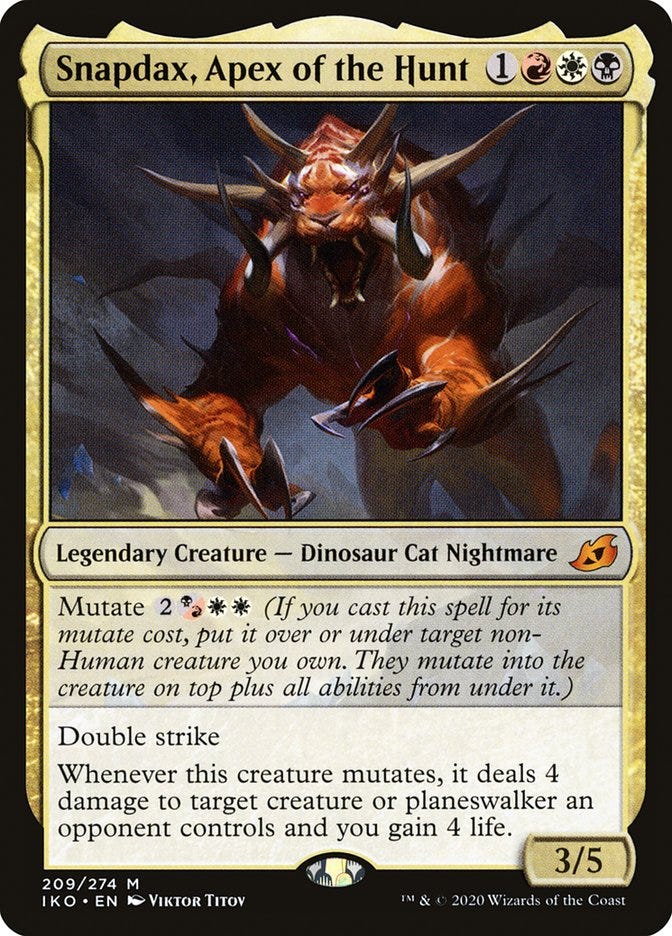
Beginning with the post-cranial skeleton (the part of the skeleton that isn’t the skull), a number of the features are in the beginning stages of becoming mammalian. The spine of a reptile and of a mammal are different in an important way. A reptile generates leverage for movement by bending its spine side-to-side. Think about how a snake slithers or a crocodile or lizard runs. A mammal by contrast bends it’s spine up and down to generate leverage. Think of how a whale paddles or a cheetah runs. Both spines have limited abilities to flex in any direction, but they are usually specialized for one. The spine of a gorgonopsian appears to be somewhat in the middle. It is beginning to be able to flex vertically, but it isn’t fully specialized for it yet. Reptile and mammal locomotion also differs when it comes to their legs. Reptiles tend to run in what is called a “sprawling gait,” meaning their legs point laterally away from their bodies and then turn downwards to meet the ground. Mammals have what is called an “erect gait,” meaning their legs point straight down from their bodies. The trade off for these two is that a sprawling gait is generally more maneuverable, while an erect gait is generally faster. The gorgonopsians seem to have adopted a mostly erect gait, bringing them one step closer to becoming mammals. Its important to point out that dinosaurs also evolved an erect gait, which is where modern birds get it, so there may be a correlation between the faster-paced lifestyle that an erect gait enables, and the endothermic processes that both groups were in the process of developing.
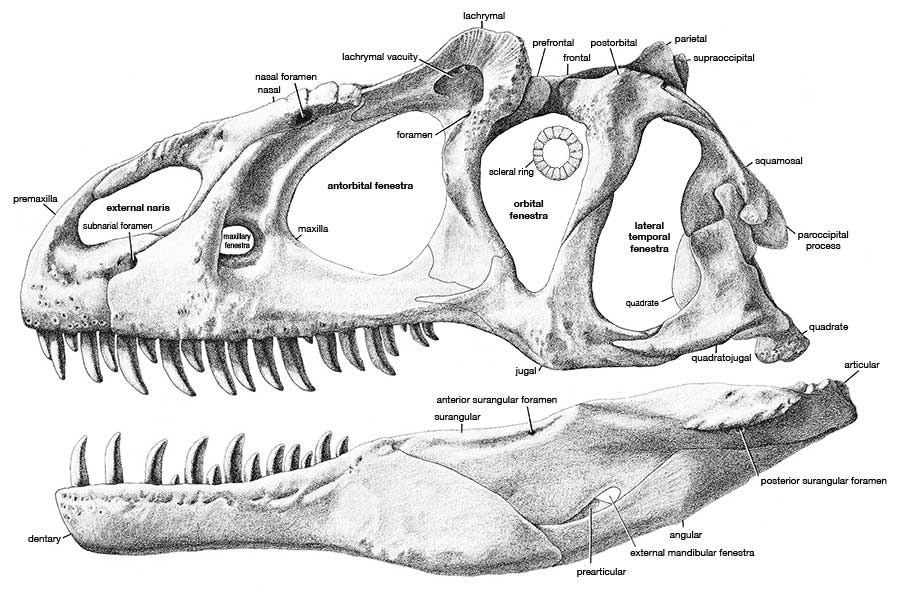
Now it is here we begin our discussion of the fossil skulls. I lead with Allosaurus as an example of what the features we’re about to elucidate look like in an average reptile skull. We’re going to start by looking at the nose. When you look at the skull of a mammal, there is a clear void where the nose would be. This is because the structure of a mammal’s nose doesn’t come from the bone, it comes from cartilage, which decays away much quicker than bone and so doesn’t preserve well. Meanwhile a reptile has a bony nose, usually just appearing as a noticeable hole or pair of holes at the front of the skull. The nose of a gorgonopsian is pretty distinctly reptilian. Next lets look at teeth. Mammals are known for being heterodonts, meaning they have different types of tooth shapes. Reptiles are typically homodont; with just one type of teeth, though a few dinosaurs did separately develop heterodonty. Looking at the skull of a gorgonopsian reveals one major type of tooth that differs from the others: the pair of massive canines reminiscent of the much later sabre-toothed cats. Gorgonopsians also have incisors which differ from their post-canine teeth subtly, though they haven’t yet developed the full range of tooth shapes of the true mammals (i.e. molars, etc.).
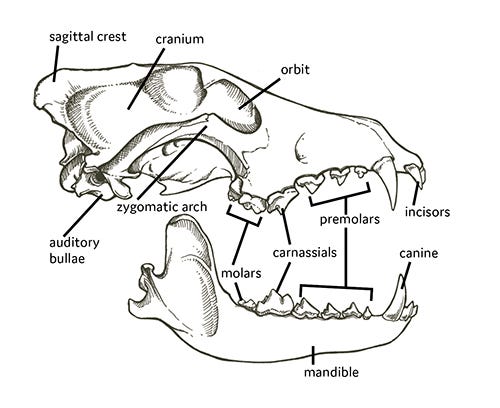
The final feature to compare requires a little bit more anatomical detail, but I think its the most illuminating one, so we’re going to delve just a little bit more. If you scroll back up to the Allosaurus skull and look at the bottom jaw, you’ll see that it’s primarily composed of three bones: the dentary which holds the teeth, the surangular which contacts the bones in the cranium to connect the top and bottom jaws, and the angular which connects the surangular to the dentary. Now with that in mind, if you check the bear skull, you’ll notice that its bottom jaw is only a single bone: the dentary. What happened to the surangular and the angular? Well, the gorgonopsian skull provides a clue. Looking at its bottom jaw, we can see that it still has the three bone structure, but the surangular and the angular have shrunk. The surangular isn’t actually as small as it appears from this sketch, its just that most of its surface area is on the in-side of the skull, but rest assured it has shrunk. These bones as it turns out would continue to shrink. In the cynodonts, there are known specimens where both the dentary and the surangular contact the cranium bones, and by the time we see the polar bear skull above, the bones seem to have disappeared entirely. What happened to these bones? It turns out that they aren’t actually gone. The mammals still have them, they just aren’t where you’d expect them. As the bones got small enough, they left the jaw and migrated a short distance upwards to become part of the middle ear. The whole thing does start to make the idea of “transitional forms” indeed look foolish, but not because we don’t find them. Rather, because it implies an end goal or final product that simply doesn’t exist. The truth is that when you allow yourself to see the world this way, everything becomes a transitional form.
As she lived peerless,
So her dead likeness, I do well believe,
Excels whatever yet you look'd upon
Or hand of man hath done; therefore I keep it
Lonely, apart. But here it is: prepare
To see the life as lively mock'd as ever
Still sleep mock'd death: behold, and say 'tis well.Paulina, The Winter’s Tale
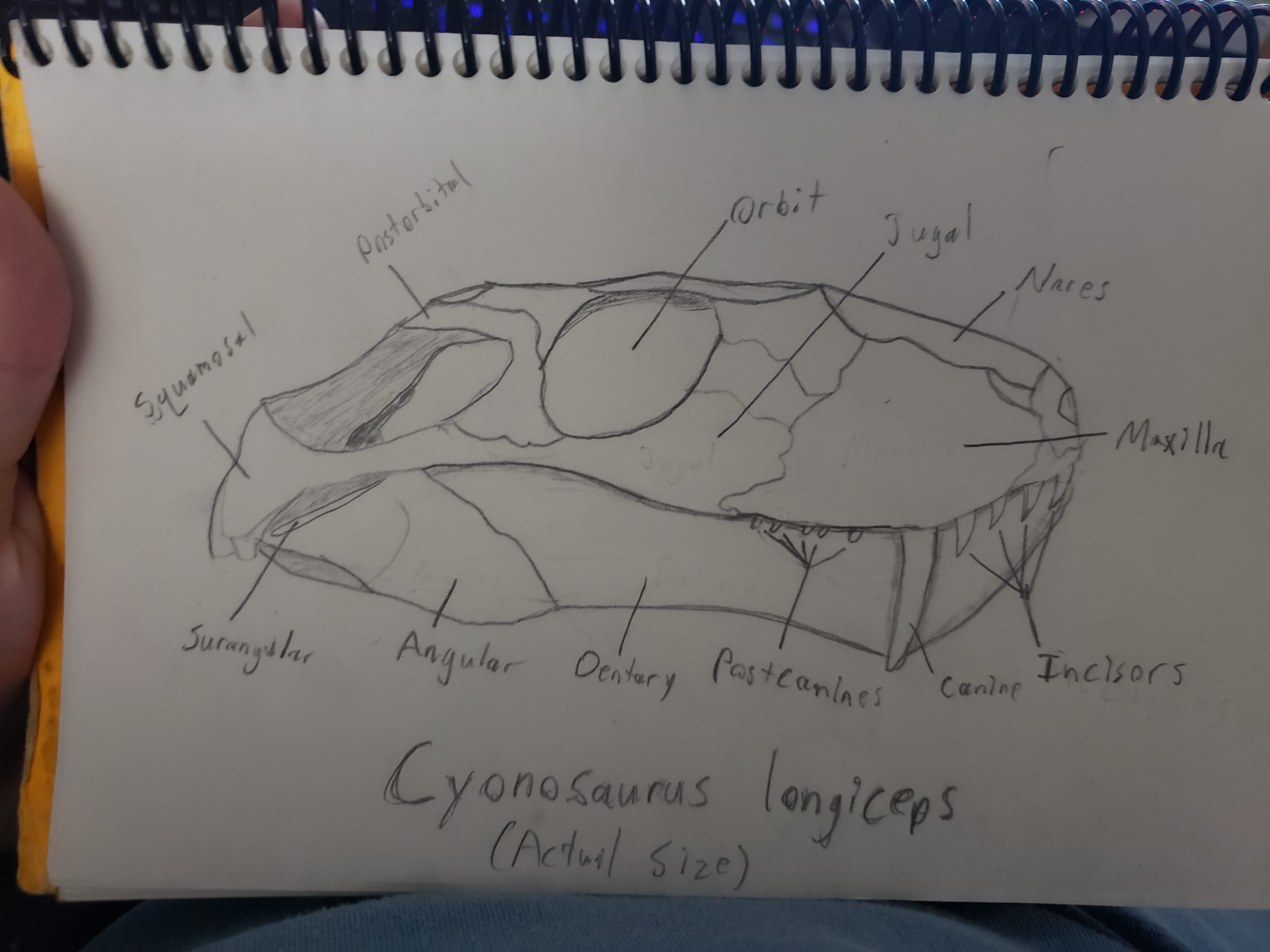
It’s been years since I tried to do a scientific sketch, but for some reason while I was concepting this essay, I felt a desire to try to draw my subject. Once again on accident (I hadn’t thought of the Winter’s Tale angle yet), I cast myself as Paulina; this time at the end of the play, revealing the “statue” of Hermione to the newly repentant king Leontes. I think the best way to learn something is to reproduce it, either by teaching it, drawing it, or simply taking notes. That’s really the ultimate purpose of this essay: for me to reproduce the line of thought that led me to questioning my assumption and changing my view, so that hopefully I can do it again in the future. Now if you’ll excuse me, there’s another habit I’m trying to break: my essays are always clawing for some grandiose philosophical point to end on, and end up with a rushed conclusion. So I’d like to take a moment and pull back the curtain on how quickly this whole The Winter’s Tale analogy really breaks down. You see, Paulina’s statue at the end isn’t actually a statue. It turns out as the scene proceeds that it was actually Hermione who had been living in hiding, so casting myself as Paulina falls a little flat when my drawing isn’t actually… uh oh
Exit, pursued by a gorgonopsian
Sources Used:
Antón, Mauricio. Sabertooth. Indiana University Press, 2013.
Divljan, Anja. “Platypus.” The Australian Museum, australian.museum/learn/animals/mammals/platypus/. Accessed 2 Aug. 2025.
Gould, Stephen Jay. “Cordelia’s Dillema.” Dinosaur in a Haystack: Reflections in Natural History, Harmony Books, New York, pp. 123–132.
Kammerer, Christian F. “Systematics of the Rubidgeinae (Therapsida: Gorgonopsia).” PeerJ, vol. 4, 26 Jan. 2016, https://doi.org/10.7717/peerj.1608.
Lovegrove, Barry. Fires of Life: Endothermy in Birds and Mammals. Yale University Press, 2019.
Madsen, James H. Allosaurus Fragilis: A Revised Osteology. Utah Geological Survey, 1993.
Olson, Everett Claire. “The cranial morphology of a new Gorgonopsian.” The Journal of Geology, vol. 45, no. 5, July 1937, pp. 511–527, https://doi.org/10.1086/624561.